Difficult Dates After Loss
New Year After Loss: When the Year Turns Without Them
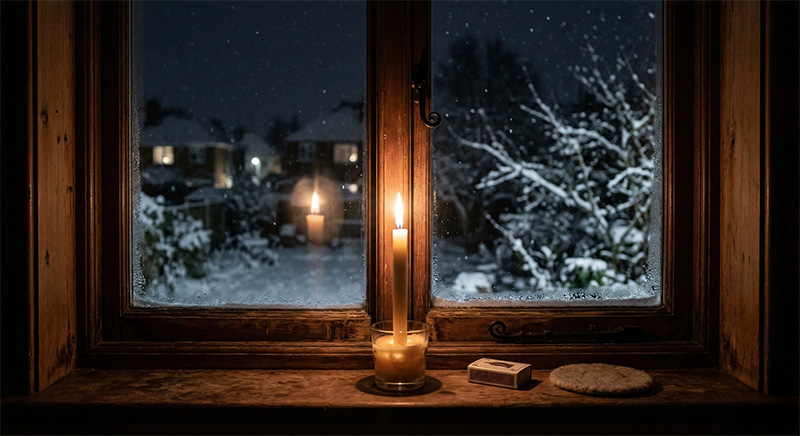
There is something about the turn of a new year that grief finds particularly hard to ignore. The world marks it as a beginning. You are still somewhere in the middle of something.
New Year is not always the occasion people expect to find difficult when they are grieving. Christmas gets more attention, and the death anniversary, and the birthdays. New Year can catch people off guard precisely because it sits slightly outside the usual list of hard dates, arriving quietly after the exhaustion of Christmas and asking something of you before you have quite recovered.
This guide is for anyone finding the turn of the year difficult after a loss. Whether you lost someone recently or some time ago, whether New Year’s Eve is the hard part or the days that follow it, whether you are surrounded by people or facing it alone.
Why New Year Feels Different After Loss
New Year carries a particular kind of symbolism that sits uncomfortably with grief. It is framed as a fresh start, a clean slate, a moment of transition from one chapter to the next. All of that is well-meaning, but it contains an implicit suggestion that the previous year is being left behind. And for someone who is grieving, leaving the year behind can feel like leaving the person behind along with it.
The year in which someone died belongs to them in a specific way. It is the last year they were alive, or the first year after they died. Moving out of it and into a new one can feel, even irrationally, like a kind of further loss. Like crossing a threshold you did not choose to cross.
There is also the matter of what New Year asks you to do. To celebrate. To be hopeful. To look forward. To make resolutions about the future. For someone in the middle of grief, the future can feel like difficult territory. The year ahead is one they will not be in. Every year that passes adds to the distance between now and the last time you saw them. Being asked to welcome that can feel like being asked to do something you are not yet ready for.
None of this means you cannot have a reasonable New Year. It just means the occasion carries more complexity than it might have done before, and it is worth going into it with that acknowledged rather than ignored.
New Year’s Eve When You Are Grieving
New Year’s Eve is built around celebration, and celebration when you are carrying a loss can feel like a performance you have not agreed to give. The pressure to be out, to be festive, to be counting down to something, can be considerable. And if you are not feeling any of those things, the gap between what the night expects and what you actually feel can be exhausting.
Some people find it easier to make a decision about New Year’s Eve well in advance rather than leaving it open. Deciding early that you will spend it quietly, or with one or two people rather than a crowd, or doing something that has nothing to do with the occasion at all, removes the daily low-level pressure of working out what to do and whether you ought to be doing something more.
If someone invites you to something and you do not want to go, you are allowed to decline. You do not owe anyone a festive New Year’s Eve. Saying no to things that are going to cost you more than they give you is not antisocial when you are grieving. It is just sensible.
If you do want to be around people, that is equally valid. There is no correct way to spend New Year’s Eve after a loss, and wanting company and noise and distraction is as legitimate a response as wanting quiet. The important thing is choosing what you actually need rather than what you feel you ought to want.
The First New Year After a Loss
The first New Year after someone dies is often the hardest, for a reason that is slightly different from the other first occasions in the grief calendar. Birthdays and anniversaries are tied to the person directly. New Year is tied to the passage of time, and the first New Year marks the first time the year itself has changed since they died.
For many people, the first New Year brings with it a complicated feeling that is hard to name. Something like: the year they died is ending. The year they were alive in is ending. The calendar is moving on in a way that the grief has not caught up with, and something about the public marking of that transition can feel very raw.
It can also be a time when the reality of the longer term settles in more fully. The acute early period of grief is often characterised by a kind of suspended quality, as though life has paused while you work out what has happened. By the time New Year arrives, particularly if the death was earlier in the year, that suspension is starting to lift. You are beginning to understand that this is not a pause. It is just the new shape of things. New Year, with its insistence on forward movement, can be the moment that understanding lands most clearly.
If the first New Year feels harder than you expected, that is not unusual. Be patient with yourself through it.
Resolutions and the Year Ahead
New Year is traditionally a time for resolutions, for setting intentions, for deciding what you want the coming year to look like. When you are grieving, all of that can feel beside the point, or actively uncomfortable.
You are not obliged to have a resolution. You are not obliged to feel optimistic about the year ahead. You are not obliged to reframe your grief as an opportunity for growth or to decide that this will be the year you heal, whatever that means. The pressure to treat loss as a catalyst for self-improvement is one of the less helpful things the culture tends to do around bereavement, and New Year concentrates it.
If you do want to set some kind of intention for the coming year, it might be worth making it gentler than a resolution. Not a goal to achieve but an orientation to move toward. Something like: I want to be a little kinder to myself this year. I want to let the people I love know that I love them. I want to keep finding ways to carry him with me. These are not targets. They are just directions.
And if the idea of any of that feels like too much, it is fine to let New Year pass without making it mean anything in particular. A new calendar is not a requirement to be a new person. You are allowed to simply carry on, at whatever pace makes sense to you, into a year that will ask things of you as they come.
When the Person Died Near New Year
If your loved one died in December or January, New Year carries an additional layer of difficulty. The anniversary of the death may be very close to New Year’s Eve or New Year’s Day, which means the two occasions stack on top of each other in a way that compounds the weight of both.
It also means that New Year may always be associated, for you, with the time they died. The particular quality of that week, the cold, the decorations still up, the way the world feels slightly suspended between Christmas and ordinary life again, may become permanently charged with the memory of their death in a way that is hard to separate from the occasion itself.
If this is your situation, it is worth giving yourself considerably more space around New Year than the occasion would ordinarily seem to require. The people around you may not understand why New Year is so hard for you several years on. You are not obliged to explain it, but it may help to have at least one person who knows the reason, so that you are not navigating the convergence of the two dates entirely alone.
Finding Something to Hold Onto in the New Year
This is not about forced optimism. It is about something smaller and more practical: having something in the weeks ahead that gives you a reason to keep moving forward, however modestly.
It does not have to be significant. Something to look forward to in January or February. A visit to someone you like. A walk somewhere you have been meaning to go. A book you have been intending to read. Something small that pulls you gently in the direction of the next few weeks rather than leaving you with nothing but an open expanse of a new year to get through.
Grief is not cured by small pleasures, and this is not that kind of suggestion. It is simply that having one or two things on the near horizon can make the beginning of a new year feel less like a vast, undifferentiated stretch of difficulty and more like something that has some shape to it.
What to Say to Someone Grieving at New Year
New Year is one of those occasions when people who are not grieving can underestimate how hard it is for people who are. The festive nature of the occasion, and the cultural emphasis on fresh starts and looking forward, can make it feel like grief should be taking a back seat. It is not.
If you know someone who is carrying a loss into the new year, reaching out to them costs very little and tends to mean a great deal. You do not need to know the right thing to say. Simple and genuine is more than enough.
“Thinking of you as the year turns. I know this one has been hard and I just wanted you to know I’m thinking of you.”
“Wishing you a gentle new year. Thinking of you and [their name] as we go into it.”
“I know New Year can be a strange one when you’re grieving. Just wanted to say I’m here if you need anything.”
You are not being asked to solve anything or say the perfect thing. You are just being asked to acknowledge that the occasion exists and that they are in it. For someone who is quietly dreading the countdown, knowing that someone is thinking of them can be more than enough.