Difficult Dates After Loss
First Christmas Without a Loved One: A Gentle Guide
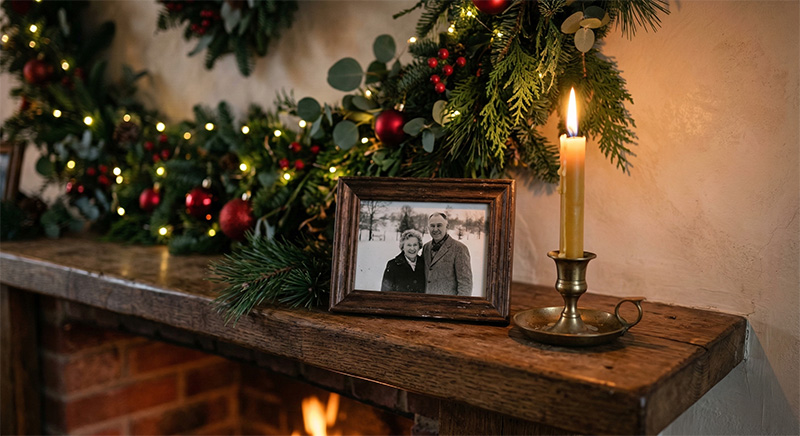
Christmas has a way of making absence louder. The more it asks of you, the more visible the gap becomes.
If this is your first Christmas without someone you love, you are probably already dreading it. Maybe you have been dreading it since the summer, when the distance between now and December still felt like a buffer. Maybe it crept up on you and the decorations in the shops arrived before you felt ready. Maybe you are reading this in the middle of it, looking for something to hold onto.
Whatever brought you here, this guide is written for you. Not to make Christmas easy, because it will not be easy. But to offer some honest company for a season that asks a great deal of people who are grieving, and to give you some gentle thoughts on how to approach it in a way that is kind to yourself.
Why Christmas Is Particularly Hard When You Are Grieving
Christmas is the most expectation-laden time of year. It asks you to be together, to be warm, to be grateful, to do the same things you always do in the same way you always do them. All of that is precisely what makes it so hard when someone is missing.
Grief at Christmas is not just about the day itself. It is about the accumulated weight of everything the season carries. The traditions that belonged to them. The role they played in how the day worked. The gap at the table that everyone notices and nobody quite knows whether to mention. The presents that were already bought, or the ones you keep forgetting you no longer need to buy. The Christmas films they always quoted. The specific way they wrapped things, or refused to wrap things, or made everyone do it differently every year.
Christmas holds so many small, specific details of a person. Losing someone before it arrives means all of those details surface at once, across an entire season, in public and in private, in ways you can prepare for and in ways you cannot.
It is a lot to carry. It is okay to say so.
There Is No Right Way to Do This Christmas
The most important thing to know going in is that there is no version of this Christmas that you are supposed to have. No correct amount of celebration, no right balance between grief and festivity, no way of spending the day that will mark you out as either grieving too much or not enough.
Some people find that keeping traditions exactly as they were brings comfort. The familiarity of the usual routine, the sense that the person is still present in it somehow, that their way of doing things is being honoured.
Others find that doing exactly what they always did is unbearable, because every element of it throws the absence into sharper relief. These people need something different. A change of scene, a stripped-back day, a decision to skip the whole thing and do something that carries no memory of the person at all.
Both of these responses are completely valid. So is everything in between. The goal is not to have a good Christmas. The goal is simply to get through it in whatever way costs you least and gives you most.
If you are spending Christmas with other people, it helps to have a conversation before the day about how everyone is feeling and what they need. People in the same family, grieving the same person, can want very different things from the day. Assuming everyone will naturally want what you want tends to lead to friction. Talking about it in advance, even briefly, tends to lead to something more manageable.
Practical Things That Can Help
Give yourself an exit
Whatever you have planned for Christmas Day, try to make sure you have a way to step away from it if you need to. A walk you can take alone. A room you can go to. Permission to leave a gathering earlier than expected without having to justify it. Grief does not run on a schedule, and having somewhere to take it privately when it arrives can make the difference between a difficult day and an overwhelming one.
Decide in advance how you want to acknowledge them
One of the things that makes Christmas hard is the uncertainty around whether and how the person will be mentioned. Will someone bring them up? Will everyone try not to? Will it be awkward either way? Deciding as a family or household in advance how you want to include them in the day can remove some of that uncertainty. A toast at dinner. Their photograph on the table. A specific moment where anyone who wants to can say something. Having an intentional space for them tends to feel better than a day spent tiptoeing around whether it is okay to say their name.
Change what needs changing
If a particular tradition is going to be too hard without them, you are allowed to set it aside this year. You can always return to it. Nothing about changing one Christmas means you are changing all of them. Some families find it helpful to do something entirely new on the first Christmas after a loss, something that has no previous memory attached to it, so that the day is not spent measuring itself against how it used to be.
Keep expectations low
Christmas already carries enormous pressure under ordinary circumstances. Add grief to that and the pressure can become genuinely unmanageable. Try to strip the day back to what you can actually face rather than what you feel you should be able to manage. A smaller gathering. A simpler meal. Fewer obligations. Less time on social media watching other people’s Christmases. Permission to do less and feel less bad about it.
Plan something for the days around it too
Christmas Day tends to get all the attention, but the days surrounding it can be just as hard. Christmas Eve, Boxing Day, New Year. The whole stretch of the holiday period can feel relentless when you are grieving. Having a loose plan for each of those days, or at least knowing who you can call if they become difficult, can help stop the week from feeling like an unbroken expanse of something you just have to survive.
Ways to Include Them in Christmas
Many people want to find a way to bring their loved one into Christmas rather than simply marking their absence from it. There is no obligation to do this, but for those who find it helpful, here are some ideas.
A place at the table
Some families set a place for the person who has died, with a candle or a flower or a photograph. Others find this too painful. If you think it might help, it is worth raising the idea with the people you are spending Christmas with beforehand rather than on the day, to make sure everyone is prepared for it.
A dedicated ornament or decoration
A bauble engraved with their name, a decoration that belonged to them, a new one bought specifically to represent them on the tree. These small objects can become a way of keeping them part of the season year after year.
Cooking something of theirs
A recipe they always made. A dish that was theirs in the family. Cooking it, or eating it, or teaching someone else how to make it can bring them into the day in a way that feels warm rather than only sad.
Giving in their name
Making a donation to a cause they cared about, or doing a Christmas act of kindness in their memory, can make the season feel purposeful. A way of extending something of them into a world they are no longer in.
Telling stories about them
This one costs nothing and is often the most meaningful thing you can do. Telling a story about them at dinner, bringing them into the conversation in the way they would have been when they were alive. It can feel strange to initiate at first, but most people find that once someone starts, others follow. Hearing someone else’s story about a person you love is a particular kind of gift, and Christmas, when families gather, is one of the best times to give it.
If You Are Spending Christmas Alone
Not everyone grieving at Christmas has a family to spend it with, or wants to spend it with the family they have. Some people are facing Christmas alone for the first time after losing a partner. Some have lost the person who was the centre of their family, and without that centre, the usual gathering has quietly fallen apart.
Spending Christmas alone when you are grieving is genuinely hard, and it deserves to be said plainly rather than papered over with advice about keeping busy. The day is long. The world around you is loud with togetherness. The contrast can be painful.
A few things that can help. Planning the day into sections, so it does not feel like one unbroken stretch of time. Having something to watch, or listen to, or make, that gives the hours a shape. Reaching out to someone in the morning, even briefly, so that the day begins with some form of connection. Giving yourself permission to feel however you feel without adding a layer of judgment on top of it.
If you know someone who is likely to be alone at Christmas and grieving, reaching out to them before the day to check in is one of the most useful things you can do. You do not need to solve anything. You just need to make sure they know they have not been forgotten.
When Children Are Involved
If you are spending Christmas with children who are also grieving, the day carries an additional layer of complexity. Children experience grief differently at different ages, and Christmas can bring feelings to the surface that have been quiet for weeks.
Young children often need the familiar. Keeping as much of the usual routine as you can manage gives them a sense of stability at a time when a great deal has changed. They may ask questions about the person who has died, possibly at moments you are not prepared for. Try to answer honestly and simply, without feeling that you have to have the perfect response.
Older children and teenagers may find Christmas harder to talk about. They may seem fine and then not be fine. They may cope by withdrawing, or by being loud and resistant to anything that feels like forced togetherness. Giving them some control over how they spend parts of the day, rather than requiring full participation in everything, can help.
Whatever the age, the most important thing is that the person who has died is not treated as someone who cannot be mentioned. Children need to know that it is okay to talk about them, to miss them out loud, to bring them into the day without the adults around them shutting down.
The Days After Christmas
For many people, the days immediately after Christmas are the hardest part. The build-up is over. The people who were around have gone home. The house is quiet in a way that amplifies the absence rather than softening it. The new year is visible on the horizon, carrying its own weight of firsts and transitions.
If you know this is likely to be hard, plan for it. Not with elaborate activities, but with the same low-level kindness you would show yourself on any difficult day. Someone to see, or call. Something small to look forward to. Permission to feel flat and depleted after a season that has asked a great deal of you.
You have got through Christmas. That is not a small thing. Be gentle with yourself in the days that follow.